Report a Road or Water Issue
Scott Ovitt, Road Foreman
montgomeryroads.scott@gmail.com
Road Emergency: 802-370-5650
Town Garage: 802-326-4418
Water Operator- Ross Dunham
508-776-7462

Official Municipal Website
Official Municipal Website
A decision has been issued by the Zoning Administrator for the following permits: Thompson 10-2-26
Notice of Public Hearing of the Development Review Board: Macauley 10-22-26
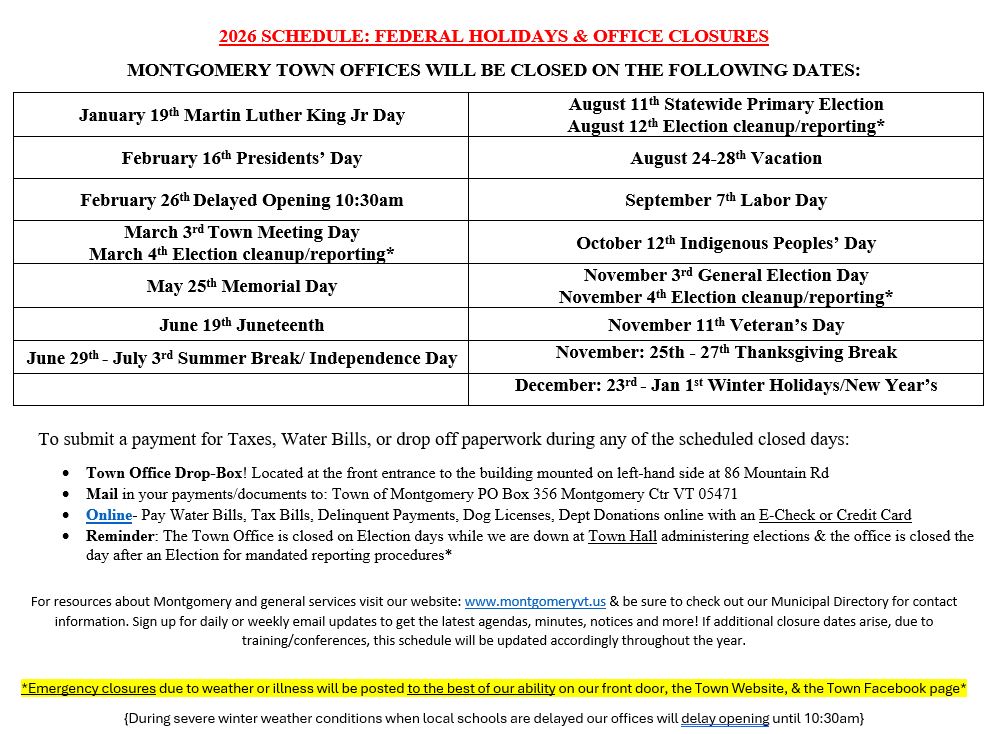
| Hours | Fridays: 9:00a-12p 2026 Holiday & Office Closure Schedule |
| Location | Public Safety Building 86 Mountain Rd. / VT-242 Montgomery Center, VT 05471 |
| P.O. Box 356 Montgomery Center, VT 05471 | |
| Phone/ Email | 802-326-4719, Ext 205 / montgomeryzoning@gmail.com Visit our Municipal Directory for more information |
Understanding Vermont Wetlands
Wetlands are where land and water meet. They are commonly called marshes, swamps, and bogs. Class II wetlands and their 50-foot buffer zones are regulated in Vermont because of the functions they provide, like flood water storage, water quality protection, and wildlife habitat. The location of wetlands is hard to identify because their hydrology and vegetation can change throughout the seasons. While the State has been working to update the Vermont Significant Wetlands Inventory (VSWI), many protected wetlands remain unmapped.
Activity in a state-protected wetland or its associated 50-foot buffer zone is prohibited unless the activity is considered exempt, is an allowed use under the Vermont Wetland Rules, or is authorized by a wetland permit. However, not all projects can receive a state wetland permit. Before you start planning, check for wetlands on or near a property.
Step 1: Identify if there is a wetland on your property
Visit the Check for Wetlands Before You Buy or Build Website for a comprehensive overview of how landowners and land buyers can check for wetlands.
Step 2: Contact Wetlands Staff
If a property has a wetland, and a project might impact the wetland or its 50-foot buffer zone, Contact Wetlands Staff. The time and money it takes to fix a wetland violation are more than the cost to get a wetland permit before building.